“We are too small to be a target”– A blog to dispel the myth

Survey Metrics Highlight 88% Ransomware Concentration on SMBs & Local Governments
For years, a pervasive myth persisted in boardrooms, municipal offices, and city halls across the country: "We are too small to be a target."
Recent industry telemetry and global breach reports have conclusively shattered that assumption. Industry survey metrics reveal an alarming reality 88% of all ransomware breaches now target small-to-medium businesses and local government entities.
While news headlines focus on Fortune 500 conglomerates, threat actors have quietly shifted the vast majority of their operations toward regional organizations, municipal services, and mid-market firms. Cybercriminals have recognized that while large enterprises maintain dedicated Security Operations Centers (SOCs) and multi-million-dollar defense budgets, SMBs and local municipalities operate with lean IT teams, legacy infrastructure, and limited resources.
To cybercriminals, smaller organizations represent high-probability, low-resistance targets.
The Hidden Risk: What Lean Teams Fail to See
When business owners, town administrators, and IT managers evaluate their security posture, they typically focus on obvious threats: email phishing, missing antivirus software, or standard password policies. However, modern threat actors bypass traditional defenses by exploiting risks that lean organizations frequently overlook:
- Vulnerability Debt and Legacy Infrastructure: Many local municipalities and SMBs operate legacy operational hardware, unpatched edge routers, or outdated server operating systems. Attackers systematically scan the internet for multi-year-old vulnerabilities left unmanaged on smaller networks.
- Non-Human Identity & Cloud Exposure: From unmonitored API endpoints to open-source file-sharing proxies (such as self-hosted cloud storage or AI integration layers), non-human credentials and misconfigured cloud permissions are frequently left open without multi-factor authentication or privilege monitoring.
- The "Micro-Extortion" Strategy: Attackers are no longer just demanding millions from massive corporations. Ransomware-as-a-Service (RaaS) groups increasingly deploy micro-extortion schemes, demanding smaller payouts ($10,000 to $50,000) from small businesses and municipal budgets. These amounts are calculated to fall just under mandatory cyber insurance reporting thresholds, pressuring victims into quiet, rapid payouts.
Attack Frequency & The Speed of AI Compression
The sheer volume of attacks targeting smaller organizations has reached unprecedented levels. Recent metrics indicate that mid-market organizations experience scores of attack attempts every year, transforming cybersecurity from a periodic worry into a daily operational battle.
Even more critical than the frequency of these attacks is their speed.
In the past, a cyber intrusion followed a multi-week trajectory. Human attackers would manually scan a network, map microservices, escalate privileges, and slowly move laterally before deploying ransomware.
That time window no longer exists.
Threat actors now deploy automated AI agents and lightweight scripts that execute the initial stages of an intrusion simultaneously. What once took human hackers two weeks to execute reconnaissance, credential scraping, secret management exploitation, and privilege escalation is now compressed into less than 10 hours.
When AI-assisted automation scans for exposed vulnerabilities and executes attack chains within hours of a disclosure, human-speed defense is simply no longer fast enough. Organizations relying on manual patching or slow alert triage are attempting to fight a machine-speed attack with human-speed processes.
How ThreatLock Cyber Defends Your Perimeter
At ThreatLock Cyber, we operate under a core principle: while cyber threats are evolving toward enterprise-level complexity, your defense shouldn't have to be overwhelming. Small businesses and local governments should not have to face machine-speed adversaries alone or bankrupt their operational budgets to achieve real security.
ThreatLock Cyber directly levels the playing field for lean organizations through actionable, high-velocity intelligence and defense capabilities:
- Targeted SMB & Public Sector Threat Intelligence: We cut through the noise to deliver actionable, prioritized intelligence briefings. We tell you exactly which vulnerabilities are being actively exploited in your specific technology stack so your lean IT staff knows where to focus immediate effort.
- Rapid Vulnerability & AI Surface Auditing: ThreatLock Cyber helps identify the blind spots that attackers target first—unmonitored legacy hardware, exposed cloud file shares, and unauthorized "Shadow AI" implementations that introduce credential exposure.
- Closing the Defensive Time Gap: By prioritizing critical edge vulnerabilities, auditing local endpoint administrative permissions, and enforcing strict privilege controls, ThreatLock Cyber helps eliminate the easy pathways attackers use to compress their kill-chains.
- Budget-Aligned Security Leadership: We remove the friction of complex enterprise security deployments. We provide the tailored clarity, continuous oversight, and strategic guidance required to ensure your infrastructure stays defended no matter the size of your team or budget.
Cybercriminals don't care about the size of your organization or the nobility of your community mission. But ThreatLock Cyber does.
Don't wait for a compressed attack to breach your perimeter. Contact ThreatLock Cyber today to audit your risk and lock down your network.
The Wild West of SMB Workplace AI

Every major technological shift feels a bit like a gold rush. The promise of massive efficiency gains has organizations sprinting to adopt Artificial Intelligence. But right now, inside many companies, that sprint has turned the corporate network into the digital equivalent of the Wild West, a lawless frontier where speed trumps safety, and everyone is making up their own rules.
When cybersecurity professionals talk about AI risk, they often focus on highly technical threats: weaponized malware, sophisticated deepfakes, or complex code-level vulnerabilities.
Those are real. But they aren't the biggest immediate danger to your business.
The most critical operational threat right now isn't an outside hacker exploiting a flaw in your AI.
It’s the fact that you have no idea which AI tools your employees are using, what data they are feeding into them, or where that data is going.
Welcome to the era of Shadow AI.
The Frontier Mentality: Good Intentions, High Risk
Shadow AI happens when employees use unauthorized, unvetted AI applications to get their jobs done faster. It’s rarely malicious. A marketer uses an open-source tool to summarize a confidential client brief. An engineer pastes proprietary code into a free chatbot to debug it. A finance analyst uploads Q3 projections to get a quick chart layout.
In every single one of these scenarios, the employee is just trying to be efficient. But in the process, they are effectively walking out the front door and handing corporate crown jewels to a third-party platform with unknown security protocols.
Once data enters a public, consumer-grade AI model, it’s gone. It can be used to train future iterations of the model, potentially exposing your intellectual property, compliance data, or customer PII (Personally Identifiable Information) to competitors or the public.
The Reality Check: You can't secure what you can't see. If your organization doesn't have visibility into AI traffic, you are operating blind on the frontier.
Governance, Not Restriction
The solution isn't to lock down the network and ban AI entirely. That approach fails every time, it just drives the behavior further underground. Instead, surviving the Wild West requires bringing law and order to the frontier through proactive visibility and governance.
- Audit Your Traffic: Identify the AI endpoints currently interacting with your network. You might be surprised by how many unique AI tools are already pulling data from your environment.
- Establish Clear Boundaries: Define what data is entirely off-limits for public AI consumption (e.g., source code, customer PII, unannounced financial data).
- Provide Secure Alternatives: Give your team access to vetted, enterprise-grade AI tools with strict data privacy boundaries, ensuring that inputs are never used for model training.
The AI boom is a massive superpower for businesses that harness it correctly. But without visibility and clear guardrails, it’s a wide-open vulnerability. It’s time to tame the frontier.
Every major technological shift feels a bit like a gold rush. The promise of massive efficiency gains has organizations sprinting to adopt Artificial Intelligence. But right now, inside many companies, that sprint has turned the corporate network into the digital equivalent of the Wild West, a lawless frontier where speed trumps safety, and everyone is making up their own rules.
When cybersecurity professionals talk about AI risk, they often focus on highly technical threats: weaponized malware, sophisticated deepfakes, or complex code-level vulnerabilities.
Those are real. But they aren't the biggest immediate danger to your business.
The most critical operational threat right now isn't an outside hacker exploiting a flaw in your AI.
It’s the fact that you have no idea which AI tools your employees are using, what data they are feeding into them, or where that data is going.
Welcome to the era of Shadow AI.
The Frontier Mentality: Good Intentions, High Risk
Shadow AI happens when employees use unauthorized, unvetted AI applications to get their jobs done faster. It’s rarely malicious. A marketer uses an open-source tool to summarize a confidential client brief. An engineer pastes proprietary code into a free chatbot to debug it. A finance analyst uploads Q3 projections to get a quick chart layout.
In every single one of these scenarios, the employee is just trying to be efficient. But in the process, they are effectively walking out the front door and handing corporate crown jewels to a third-party platform with unknown security protocols.
Once data enters a public, consumer-grade AI model, it’s gone. It can be used to train future iterations of the model, potentially exposing your intellectual property, compliance data, or customer PII (Personally Identifiable Information) to competitors or the public.
The Reality Check: You can't secure what you can't see. If your organization doesn't have visibility into AI traffic, you are operating blind on the frontier.
Governance, Not Restriction
The solution isn't to lock down the network and ban AI entirely. That approach fails every time, it just drives the behavior further underground. Instead, surviving the Wild West requires bringing law and order to the frontier through proactive visibility and governance.
- Audit Your Traffic: Identify the AI endpoints currently interacting with your network. You might be surprised by how many unique AI tools are already pulling data from your environment.
- Establish Clear Boundaries: Define what data is entirely off-limits for public AI consumption (e.g., source code, customer PII, unannounced financial data).
- Provide Secure Alternatives: Give your team access to vetted, enterprise-grade AI tools with strict data privacy boundaries, ensuring that inputs are never used for model training.
The AI boom is a massive superpower for businesses that harness it correctly. But without visibility and clear guardrails, it’s a wide-open vulnerability. It’s time to tame the frontier.
Every major technological shift feels a bit like a gold rush. The promise of massive efficiency gains has organizations sprinting to adopt Artificial Intelligence. But right now, inside many companies, that sprint has turned the corporate network into the digital equivalent of the Wild West, a lawless frontier where speed trumps safety, and everyone is making up their own rules.
When cybersecurity professionals talk about AI risk, they often focus on highly technical threats: weaponized malware, sophisticated deepfakes, or complex code-level vulnerabilities.
Those are real. But they aren't the biggest immediate danger to your business.
The most critical operational threat right now isn't an outside hacker exploiting a flaw in your AI.
It’s the fact that you have no idea which AI tools your employees are using, what data they are feeding into them, or where that data is going.
Welcome to the era of Shadow AI.
The Frontier Mentality: Good Intentions, High Risk
Shadow AI happens when employees use unauthorized, unvetted AI applications to get their jobs done faster. It’s rarely malicious. A marketer uses an open-source tool to summarize a confidential client brief. An engineer pastes proprietary code into a free chatbot to debug it. A finance analyst uploads Q3 projections to get a quick chart layout.
In every single one of these scenarios, the employee is just trying to be efficient. But in the process, they are effectively walking out the front door and handing corporate crown jewels to a third-party platform with unknown security protocols.
Once data enters a public, consumer-grade AI model, it’s gone. It can be used to train future iterations of the model, potentially exposing your intellectual property, compliance data, or customer PII (Personally Identifiable Information) to competitors or the public.
The Reality Check: You can't secure what you can't see. If your organization doesn't have visibility into AI traffic, you are operating blind on the frontier.
Governance, Not Restriction
The solution isn't to lock down the network and ban AI entirely. That approach fails every time, it just drives the behavior further underground. Instead, surviving the Wild West requires bringing law and order to the frontier through proactive visibility and governance.
- Audit Your Traffic: Identify the AI endpoints currently interacting with your network. You might be surprised by how many unique AI tools are already pulling data from your environment.
- Establish Clear Boundaries: Define what data is entirely off-limits for public AI consumption (e.g., source code, customer PII, unannounced financial data).
- Provide Secure Alternatives: Give your team access to vetted, enterprise-grade AI tools with strict data privacy boundaries, ensuring that inputs are never used for model training.
The AI boom is a massive superpower for businesses that harness it correctly. But without visibility and clear guardrails, it’s a wide-open vulnerability. It’s time to tame the frontier.
AI is the new Invisible Predator
Why Weaponized AI is the New SMB Nightmare
For years, small and mid-sized businesses (SMBs) operated under the "security through obscurity" myth—the idea that they were too small for major hackers to notice.
Weaponized AI has officially killed that myth.
Here is why AI-driven threats are becoming a primary concern for the modern enterprise:
1. Hyper-Personalized Phishing at Scale
In the past, you could spot a scam by its poor grammar or generic "Dear Customer" greeting. Today, AI can scrape your LinkedIn profile, analyze your company’s writing style, and generate a perfectly phrased email from your "CEO" requesting an urgent wire transfer. It’s no longer a spray-and-pray method; it’s an automated, surgical strike.
2. Speed That Outpaces Human Defense
Human hackers need sleep; AI does not. Automated tools can scan your network for vulnerabilities thousands of times per second. By the time your IT team notices an anomaly, an AI-driven breach may have already encrypted your data, exfiltrated customer records, and wiped its own digital footprints.
3. The "Deepfake" CEO
We have entered an era where "seeing is believing" no longer applies. Sophisticated AI can replicate voices and video in real-time. Imagine a Zoom call where your business partner’s voice sounds exactly right, asking for sensitive login credentials. For an SMB without a dedicated security operations center, these attacks are nearly impossible to detect.
4. Quantum-Ready Threats
As we look toward the future, the arrival of quantum computing threatens to break the standard encryption that currently protects your bank accounts and private data. Hackers are already using AI to harvest encrypted data today, planning to decrypt it tomorrow once quantum power is fully realized.
The Bottom Line
AI is a "force multiplier." It gives low-level bad actors the capabilities of a nation-state. For SMBs, the threat is no longer a matter of if, but when.
The good news? You don’t have to fight AI with manual labor. By partnering with experts who use advanced, proactive cyber solutions, you can fight fire with fire—using defensive AI to neutralize the weaponized version before it ever touches your data.

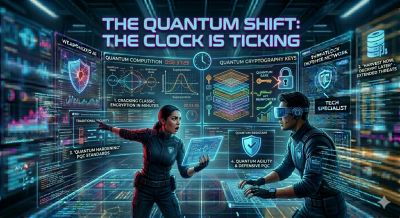
The Quantum Clock is Ticking: What SMBs Need to Know
While weaponized AI is the threat of today, Quantum Computing is the looming shadow of tomorrow. For most small and mid-sized businesses, "Quantum" sounds like science fiction, but in the hands of cybercriminals, it represents the ultimate skeleton key.
Here is how the quantum shift is fundamentally changing the security landscape for your business:
1. The Death of Standard Encryption
The encryption that currently protects your bank transfers, customer passwords, and private emails (like RSA and ECC) relies on math problems that would take today’s most powerful supercomputers thousands of years to solve. A cryptographically relevant quantum computer could potentially crack them in minutes.
2. "Harvest Now, Decrypt Later"
You might think, "I don't have a quantum computer, and neither do local hackers." Unfortunately, sophisticated threat actors are already engaging in Harvest Now, Decrypt Later (HNDL) attacks. They are stealing and storing your encrypted data today, waiting for the moment quantum technology becomes available to unlock it. If your data needs to remain secret for the next 5–10 years, it is already at risk.
3. The Widening Security Gap
Large corporations and government agencies are already migrating to Post-Quantum Cryptography (PQC). The danger for SMBs is falling behind. As enterprise-level targets become "quantum-hardened," attackers will pivot to the path of least resistance: smaller businesses that haven't updated their infrastructure.
4. A New Era of "Quantum-Safe" Solutions
The news isn't all grim. The same era bringing these threats is also giving birth to Quantum-Resistant Ledgering and new security protocols. The shift for SMBs is moving from "static" security (set it and forget it) to "agile" security—having a partner who can swap out compromised encryption methods for quantum-safe ones in real-time.
How to Prepare Today
You don't need a PhD in physics to protect your business. You need Quantum Agility.
This means:
- Inventorying your data: Knowing what info has a "shelf life" that extends into the next decade.
- Partnering for the future: Working with cyber partners who are already integrating NIST-approved post-quantum standards into their stacks.
The quantum transition isn't just an IT update; it's a survival strategy. The businesses that address these shifts today will be the only ones standing when the "Quantum Dawn" arrives.
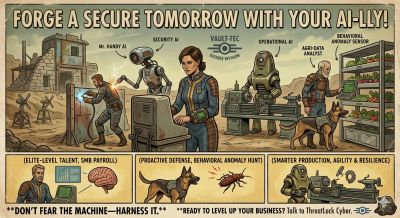
Beyond the Fear: Why AI is the SMB’s New Superpower
We’ve spent a lot of time talking about "weaponized AI," but it’s important to remember that AI isn’t just a bigger sword for the bad guys—it’s a stronger shield for you. For small and mid-sized businesses, AI is the ultimate "force multiplier" that finally levels the playing field against enterprise-level threats.
Here is why the AI revolution is actually the best thing to happen to SMB security:
1. Leveling the "Human Talent" Gap
Big corporations have the budget for 24/7 security teams. SMBs usually don’t. AI fills that gap by acting as a digital security officer that never sleeps, never takes a lunch break, and can process data faster than a room full of analysts. It allows you to have elite-level protection without the elite-level payroll.
2. Hunting the "Invisible" Before it Strikes
Traditional antivirus software only looks for threats it has seen before. Defensive AI is different; it looks for behavioral anomalies. If a user suddenly logs in from a new country and starts downloading files at 3:00 AM, the AI doesn't wait for a human to notice—it neutralizes the connection instantly. It turns your defense from reactive to proactive.
3. Automating the Mundane
Most cyber breaches are the result of simple human error: a missed patch, a weak password, or an overlooked configuration. AI handles the "digital hygiene" that humans often forget. By automating routine updates and monitoring, AI ensures your "doors and windows" are always locked, allowing you to focus on running your business.
4. Smarter, Not Harder, Productivity
Beyond security, AI helps SMBs compete by automating customer service, analyzing market trends, and streamlining operations. When you integrate AI-driven security, you aren't just buying a "firewall"—you're investing in a smarter infrastructure that makes your entire company more agile and resilient.
The Bottom Line: AI is Your Ally
The "scary" part of AI only exists if you’re standing still. When you embrace AI-driven cyber solutions, you aren't just defending your business; you're evolving it.
Don't fear the machine—harness it. By partnering with a cyber provider that uses defensive AI, you turn a potential threat into your greatest strategic advantage.
Ready to turn AI into your business's secret weapon? Let's discuss how ThreatLock Cyber can put these tools to work for you.
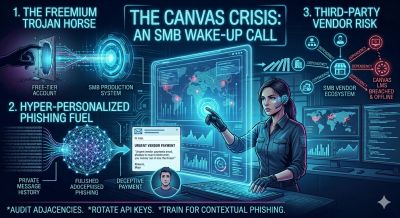
The Canvas Crisis: Why a "School" Breach is a Wake-Up Call!
In early May 2026, the education world was rocked by a massive data breach of Instructure’s Canvas LMS, the leading learning management system in North America. While you might think a "classroom hack" doesn't affect your small business, the reality is that this incident perfectly illustrates the weaponized AI and sophisticated social engineering threats we face today.
What Happened?
The notorious extortion group ShinyHunters claimed responsibility for stealing roughly 3.65 terabytes of data, impacting an estimated 275 million records across nearly 9,000 institutions worldwide.
- The Entry Point: The attackers exploited a vulnerability in the "Free-For-Teacher" account program, gaining elevated access to production systems.
- The Stolen Goods: Exposed data includes names, email addresses, student IDs, and—most critically—private messages sent through the platform.
- The Chaos: The breach forced Canvas offline during final exam periods, causing global academic disruption and leading to school-specific login pages being defaced with extortion messages.
Why This Matters for SMBs
The Canvas breach isn't just about student records; it’s a masterclass in how modern cybercriminals operate. Here is how these tactics translate to the SMB world:
1. The "Freemium" Trojan Horse
The attackers didn't breach the most hardened fortress first; they found the weakest entry point—the free tier. For SMBs, this is a reminder that every entry point matters. If your business uses "freemium" SaaS tools that share a back-end with your critical data, a vulnerability in the "free" version can compromise your entire enterprise.
2. Fuel for Hyper-Personalized Phishing
Because the hackers stole private message history, they now have the context of real conversations.
The SMB Risk: Imagine an attacker sending you an email that quotes a real conversation you had with a vendor or partner. These "surgical strikes" are nearly impossible to detect with standard filters and are used to trick employees into authorized wire transfers or credential theft.
3. Third-Party Vendor Risk
The Canvas incident highlights single-vendor dependency. When a major platform you rely on goes down or gets breached, you inherit their risk. Small businesses often lack the contingency plans to operate when their primary digital tools are suddenly disabled.
Protecting Your Enterprise
You don't need to be an Ivy League university to be a target. In fact, 59% of small and medium-sized enterprises have experienced a cyberattack.
How to stay ahead:
- Audit Your Adjacencies: Ensure that your free or low-tier accounts don't share critical access with your main business data.
- Rotate and Re-Authorize: Following a breach in your supply chain, immediately rotate API keys and access tokens to prevent follow-on attacks.
- Train for Contextual Phishing: Educate your team that just because an email contains "correct" details or quotes a past conversation, it doesn't mean it's legitimate.
The Canvas breach proves that attackers are getting more patient and more precise. ThreatLock Cyber is here to help you navigate these shifting tides, providing the advanced defenses you need to ensure today's headlines don't become your business's reality tomorrow.